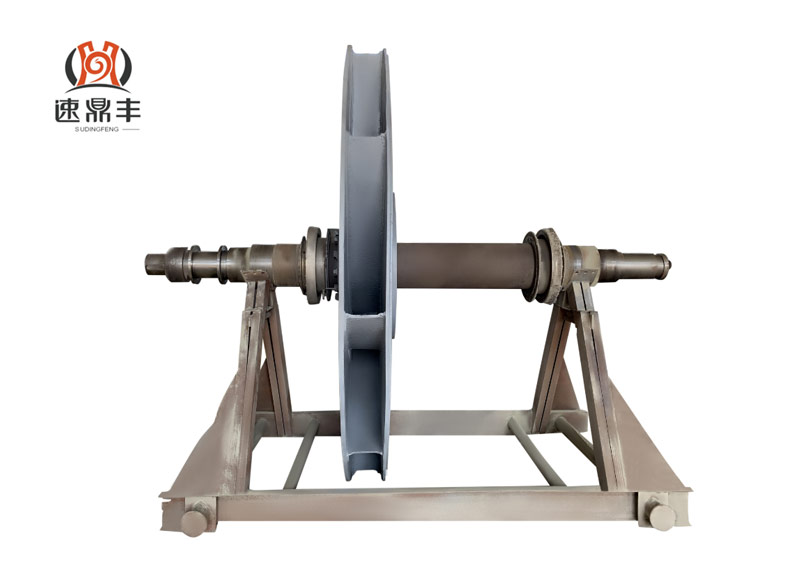
1. Equipment introduction and problem description:
The conveying fan is the key equipment of the gas line of the conveying pipeline, mainly including the blower, induced draft fan, primary fan and other types. It uses the conveying fan to increase the pressure and flow rate of the conveying medium to realize the conveying of mixed gas and meet the needs of users. The chemical composition of industrial gas is relatively complex, with more corrosive impurities and dust. Due to the continuity of production and long-term continuous operation, the more industrial gas is conveyed, the more dust will adhere to the impeller surface. Once the dust accumulates too much, it will lead to abnormal phenomena such as reduced conveying efficiency and severe vibration of the fan. In severe cases, the bearing will be damaged due to the intensified vibration of the fan. After too much dust is accumulated, it must be cleaned. The cleaning cycle is generally short. Frequent disassembly and assembly of the fan will also affect the service life of the fan.
The generation of dust accumulation on the fan impeller and the adhesion strength of the dust accumulation are affected by many factors, including the characteristics of the conveying medium, the dust concentration, and the humidity of the conveying medium. When the exhaust gas flows through the impeller, a large amount of fine dust collides and settles near the front and rear edges of the non-working surface of the blade and the rear edge of the working surface of the blade near the rear disc of the impeller. In addition, the dust adhesion is large at high temperature, which increases the probability of deposition. It is not difficult to see that the dust concentration and humidity of the conveying medium are key factors.
When the dust accumulation on the fan impeller reaches a certain level, the dust accumulation needs to be cleaned. The more commonly used cleaning methods include manual mechanical cleaning, high-pressure water washing, etc. No matter which method is used, most of them are temporary preservation and do not improve the generation of dust accumulation.
Application range: fans, dust boxes, silos, chutes, filter funnels and housings,
Effect: no adhesion effect on dust media with low moisture content
Application area: maximum temperature is 250°C
Properties: aqueous suspension, solvent-free
Application environment: dry flowing materials (dust, granular materials)
Anti-ash deposition coating on impellers is a new maintenance mode that has been highly praised internationally in recent years. The principle is to spray a layer of wear-resistant anti-stick coating on the surface of the impeller, which can effectively delay the occurrence of ash deposition and extend the interval between equipment maintenance by more than ten times or even longer. Huatong fan G-2 non-stick coating adopts Germany's advanced non-stick coating industrial technology; the performance is relatively reliable.
The air temperature in industrial flue gas systems is mostly between 100°C and 220°C. After the filter separates the air and the solid particles it carries, it will adhere to the wall of the dust box, which will cause failures and short-term maintenance and cleaning time, and sometimes unplanned downtime for maintenance. When adhered to the fan, the adhesion layer will cause the rotor to lose balance and damage the bearing.
The G-2 anti-stick system is a two-layer protection system based on bonded nanoparticles, including a primer with corrosion-reducing properties and a substantial non-stick coating, which can prevent dust and other dry particulate materials from adhering to flue management equipment and devices and particulate material storage and guide devices. G-2 Non-Stick Coating is a tribological non-stick coating for low temperature applications in industrial processes up to 250°C. The product is a two-layer water-based coating (primer coating and functional non-stick coating). Hardening takes 12-24 hours at room temperature. G-2 Non-Stick Coating improves the flow of dusty media and thus prevents the adhesion of powders and dust. The tribological properties of the non-stick coating increase the friction properties of the separator and prevent the adhesion of dusty media. Some slight adhesion may remain and needs to be removed by light cleaning (by air blow gun). The coating also protects the substrate from corrosion.
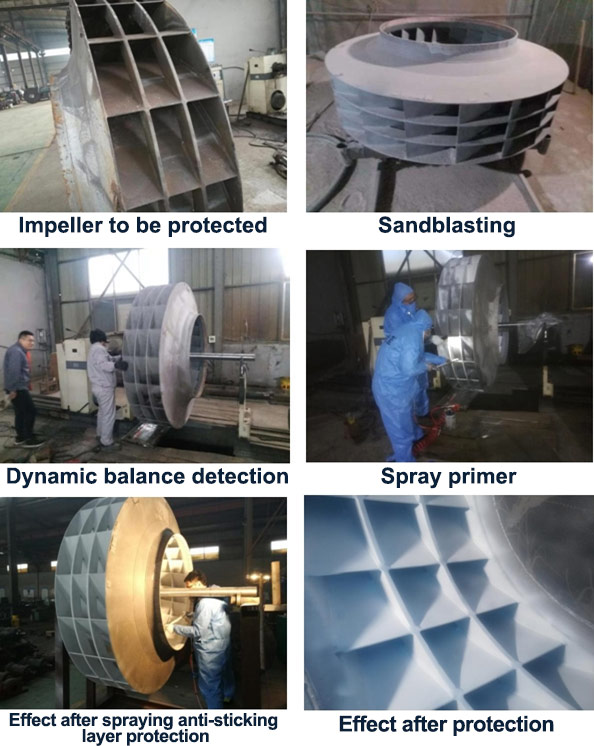
1) First, perform dynamic balancing test on the protective impeller and ensure that it meets the operating requirements;
2) Sandblast the surface without any dead corners. Make sure the surface is clean, free of grease, oxide layer and dust. Any surface residue may affect the adhesion of the coating. The sandblasting standard reaches SA 2.5 level or Ra 0.2~0.3 level;
3) Ensure that there is no dust in the construction environment during the application and curing process. The construction environment temperature is >15℃/60℉; low humidity and good ventilation conditions are required (to promote the progress of curing);
4) Connect the air source, the paint spray gun pressure is 2.0~3.0 bar (psi 30~45); the airless spray pressure is 150-200 bar (psi 2000~3000);
5) Use a stirrer to mix the primer material and stir it thoroughly for 5~10 minutes before application;
6) Adjust the spray gun. The paint spray gun nozzle is 1.0~1.4mm, and the airless spray nozzle is 0.3~0.4mmmm. Make sure the spray gun has a fine atomization. Spraying with a larger flow rate will not help.
7) Apply G2 primer to a coating thickness of no less than 30~40µm and no more than 60µm. Please note that the coating thickness can be achieved by spraying multiple times, but the total thickness cannot exceed the recommended coating thickness. If the fan metal surface is very rough, you can spray a little more to make it flat. Please also pay attention to the movement during application. In any case, avoid spraying too much at a time in a small area to avoid tearing the coated surface;
8) Before applying the second topcoat, cure at room temperature for 2 hours to dry the primer surface;
9) Apply G2 topcoat as the primer (as above) and evenly cover the primer material. The topcoat coating thickness must be no less than 40~80µm and no more than 100µm. As with the primer, the coating thickness is very thin and finally completely coated;
10) After 12 hours, wait for it to cure and use a thickness gauge to check the spray thickness;
11) Polish the cured surface with a clean cotton cloth. Polishing is necessary to achieve a smooth surface. The smooth coating surface can ensure non-stick performance;
12) Perform dynamic balancing test again, and repair the unqualified points with materials.
6. Construction application illustration: